
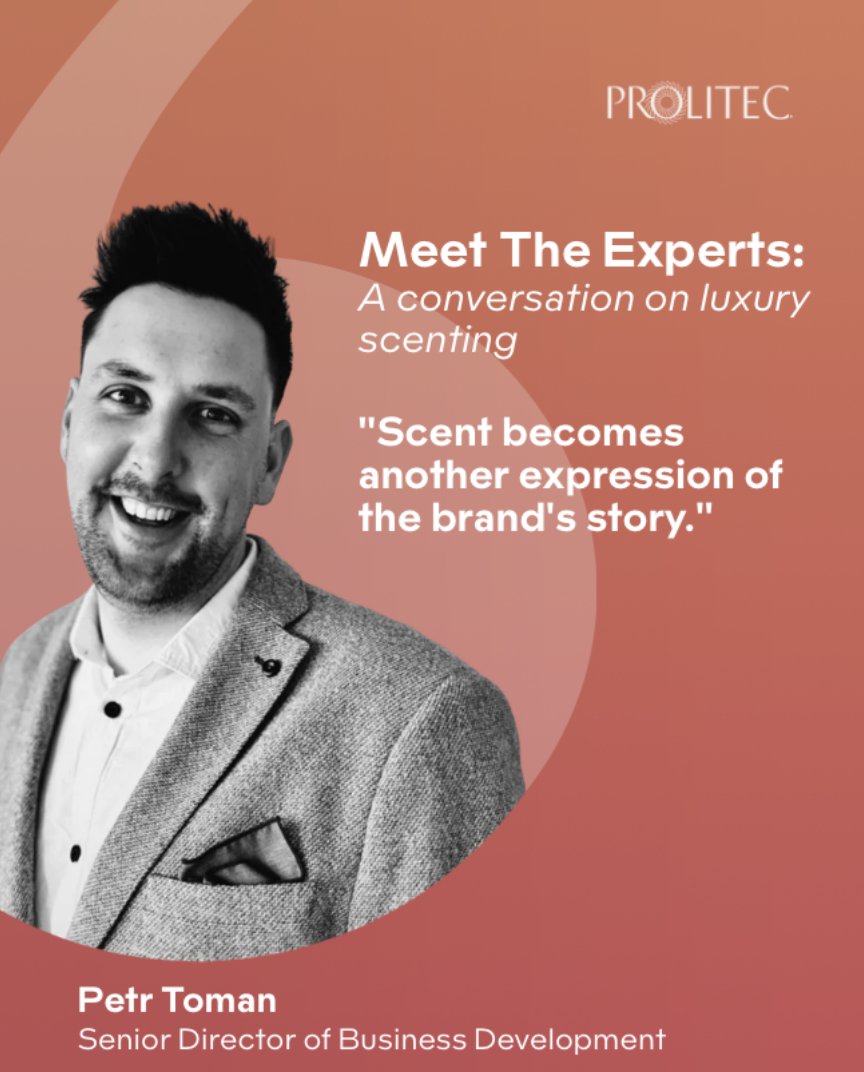
To explore the role of ambient scenting in the luxury sector, I sat down with Petr Toman, Senior Director of Business Development for Europe and LATAM at Prolitec. We discussed why more luxury brands are investing in scent as part of their customer experience strategy.
“In luxury retail, the goal is not simply to sell a product. It’s to create a feeling that customers will remember long after they leave.”
Great Brands Design Every Detail — Including the Air
When asked what sets luxury brands apart, Petr pointed to their ability to manage every aspect of the customer’s experience.
“They focus on emotion, atmosphere, and storytelling,” he explained.
From architecture and lighting to music, digital signage, and scent, every element is intentionally selected to reinforce the brand’s identity.
For luxury brands, fragrance isn’t an isolated marketing tool. It’s one more design element contributing to a carefully orchestrated brand experience.
How Do You Turn a Brand’s DNA Into a Fragrance?
Creating a signature scent isn’t simply about choosing a pleasant fragrance.
“We always start with the brand book,” he explained. “We explore what feeling our clients want to create.”
That means examining:
- Brand history
- Core values
- Customer profile
- Visual identity
- Emotional positioning
There is no single formula for luxury scenting because each fragrance strategy should reflect what the brand wants customers to feel.
A heritage jewelry house, for example, might lean toward elegant florals or refined woody notes that communicate craftsmanship and timelessness. A luxury automotive brand may prefer sophisticated leather accords or metallic notes that evoke performance and innovation.
What Business Impact Does Commercial Ambient Scenting Deliver?
While luxury brands are often protective of their performance data, Petr outlined several outcomes companies typically seek when implementing scent programs.
Among them:
- Increased dwell time
- Greater customer comfort
- Stronger emotional engagement
- More consistent brand experiences across locations
- Enhanced brand recall over time
One of the clearest business applications Petr highlighted was the need for consistency across a global retail network.
If a customer visits an IWC boutique in Paris and later visits another in New York, the scent experience can reinforce a familiar brand identity across locations.
However, Petr emphasized that success isn’t only about choosing the right fragrance.
“It’s also about the scent levels,” he explained. “We try to create a breathable and livable scented environment.”
Will AI Reshape the Future of Scent Marketing?
Petr believes artificial intelligence will play a growing role in commercial scenting, particularly in measurement, optimization, and scalability.
“AI and analytics can help brands better understand customer behavior,” he explained. “They may help optimize scent intensity and monitor performance remotely.”
In the future, AI may even adjust fragrance intensity automatically based on real-time conditions.
Still, Petr emphasized that while AI may support optimization, it does not replace the human expertise behind luxury fragrance strategy.
“Luxury remains fundamentally emotional and human.”
Technology may optimize scent delivery, but creativity, emotion, and fragrance creation will remain firmly in human hands.
Petr’s Advice for Luxury Brands Considering Scent Marketing
Petr encourages brands to answer three simple questions:
- What emotions do we want customers to feel?
- What experience are we trying to create?
- What makes us different?
Only once those answers are clear should fragrance development begin.
His final takeaway perfectly summarizes the role of scent in luxury environments,
“The fragrance should be developed as a strategic expression of the brand’s identity rather than simply an environmental fragrance.”
Whether a company ultimately chooses to implement scent or not, the conversation raises an important question for every brand: Which parts of your customer experience are you leaving to chance? For luxury leaders, the answer is increasingly “none.”
By Lucy Goutagny