
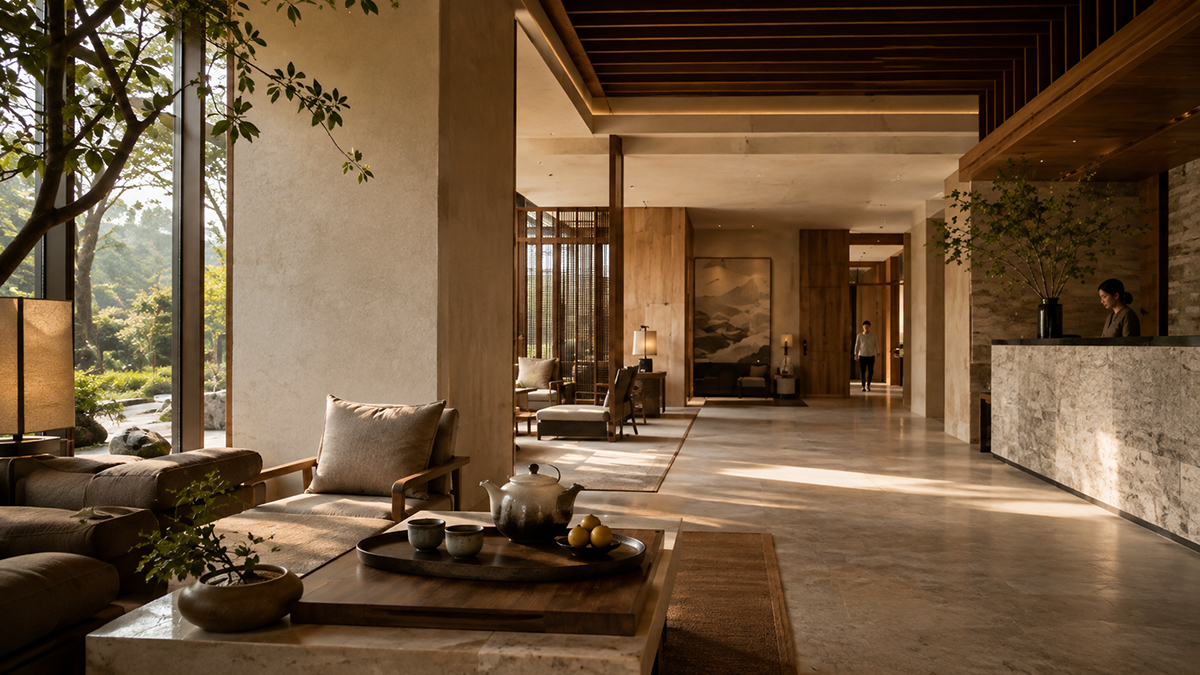
Luxury hotel fragrance isn’t becoming more intense.
It’s becoming more intentional.
For decades, hotel scenting relied on a familiar vocabulary: fresh citrus, soft florals, white tea, and crisp linen.
These notes communicated cleanliness, comfort, and care—qualities guests have long expected from a premium property.
They still do.
But today, fragrance is also expected to express a hotel’s identity, shape its emotional atmosphere, and leave guests with a memory that lasts beyond their stay ➜
That shift—from universal appeal to meaningful differentiation—is redefining luxury hotel scents.
Why Is Hotel Scenting Now a Brand Strategy?
The creative brief for hotel fragrance has changed ➜.
Instead of starting with “What will appeal to the widest audience?” luxury brands are asking more strategic questions:
- How should guests feel?
- What should they remember?
- What should this fragrance reveal about the property?
As exceptional service, premium amenities, and beautiful interiors become standard, hotels need new ways to distinguish themselves. Fragrance offers something particularly valuable: it can influence the perception of a space without competing for attention.
A successful scent does not simply complement the décor. It helps translate the hotel’s positioning into an experience guests can immediately feel.
In that sense, hotel scenting is no longer simply about making a space smell pleasant. It is about expressing a clear and recognizable identity throughout the guest journey.
What Makes the Best Hotel Scents Different?
Freshness remains essential.
Fresh citrus, florals, tea, and botanical notes remain common across hotel fragrance collections, where they are often used to create a clean, bright, or restorative impression ➜. What is changing is how luxury brands interpret those familiar scents.
The best hotel scents retain that reassuring sense of freshness while introducing greater depth, texture, and character.
The result feels familiar enough to reassure guests, yet distinctive enough to belong to one property—and no other.
Freshness remains the foundation. It is no longer the entire creative destination.
How Is Wellness Reshaping Hotel Lobby Scents?
The move toward more emotionally intentional fragrance is also broadening the role of wellness in hotel scent design ➜.
Once largely confined to spas and treatment rooms, wellness-inspired fragrances are now shaping the atmosphere of the entire property.
As travelers increasingly look for restoration alongside luxury, hotels are selecting hotel lobby scents that contribute to a calmer, more grounded guest journey.
This shift is reflected in the growing presence of ingredients such as vetiver, cedarwood, eucalyptus, rosemary, holy basil, peppermint, and frankincense.
Their appeal is not limited to their natural character. They also reinforce the restorative atmosphere many hotels want to create across bedrooms, lobbies, lounges, and shared spaces.
Wellness fragrance is becoming part of the broader hospitality experience rather than a category reserved for treatment rooms.
Why Is Tea Popular as a Hotel Lobby Scent?
Few fragrance families express this evolution as clearly as tea.
White tea has become strongly associated with hotel fragrance through signature programs such as Westin’s White Tea scent ➜. Its appeal is easy to understand: it feels clean without smelling soapy, elegant without feeling extravagant, and luxurious without overwhelming a space.
Hotel fragrance is now extending that tea vocabulary beyond white tea. EDITION, for example, uses black tea with bergamot and cedarwood ➜.
Tea works particularly well as a hotel lobby scent because it carries several associations at once: craftsmanship, ritual, refinement, and wellbeing.
It communicates sophistication with restraint.
For hotels seeking to create an atmosphere of quiet luxury, tea offers a balance between familiarity and distinction. It feels immediately welcoming without becoming generic or overpowering.
How Do Warm Woods Change the Hotel Lobby Smell?
Warm woods serve a different purpose.
Woody notes can add warmth, depth, and structure to the way a space feels ➜.
They make expansive lobbies feel more intimate.
They bring warmth to minimalist interiors.
They give contemporary properties a more residential, welcoming quality.
In this context, the hotel lobby smell becomes part of how guests experience the physical space. Fragrance can soften an imposing interior, add warmth to hard architectural materials, or create a stronger feeling of comfort and enclosure.
The objective is not to impress guests with an obvious perfume. It is to create a space that encourages guests to slow down and feel at ease.
Here, comfort becomes an expression of luxury.
Why Do Scent Machines for Hotels Matter?
The most important transformation happens before a perfumer selects a single ingredient.
Increasingly, hotels begin by defining their positioning, target guests, emotional territory, and desired guest journey. The fragrance is then developed as an olfactory expression of those choices.
This places scent alongside architecture, lighting, music, materials, and service as part of one coherent brand experience.
It also explains why investments in scent machines for hotels are increasingly viewed as branding decisions rather than purely operational ones.
A professional hotel lobby scent diffuser is not simply selected to release a pleasant fragrance into the air. It must distribute fragrance consistently, maintain comfortable intensity, and create a recognizable atmosphere across different spaces.
The technology should remain discreet ➜. Its impact, however, should be carefully controlled.
When scent distribution is inconsistent or overpowering, it can weaken the experience. When it is precisely managed, fragrance can become a consistent and familiar part of the hotel’s identity.
How Does a Signature Scent Become Part of a Hotel Brand?
The strongest signature scents can extend the relationship beyond the property itself.
Guests can even bring signature hotel fragrances home. The W Hotel scent ➜ is sold through W Hotels’ official store, while the 1 Hotel scent ➜ is available as the brand’s Kindling home fragrance.
That reveals something important: guests do not remember a hotel fragrance only as a list of ingredients. They remember it as the scent of a specific place.
At that point, fragrance is no longer simply supporting the brand.
It has become part of the brand.
A successful signature scent can therefore continue to evoke the hotel long after checkout. It becomes connected to memories of the lobby, the room, the service, and the overall feeling of the stay.
What Is the Best Hotel Scent?
Luxury is moving away from obvious signals of quality toward experiences that feel personal, intuitive, and memorable.
Fragrance is evolving accordingly.
So, what is the best hotel scent?
Not necessarily the freshest, the most expensive, or the most noticeable.
The best hotel lobby scent is the one that feels inseparable from the property itself.
It should reflect the hotel’s identity, support the desired emotional atmosphere, and remain memorable without demanding attention.
The future of luxury hospitality ➜ will not be defined by stronger fragrances.
It will be defined by more meaningful ones.
Frequently Asked Questions
What makes a hotel lobby scent different from a regular commercial fragrance?
A hotel lobby scent is selected as part of the property’s overall guest and brand experience, rather than simply to make the air smell pleasant. The fragrance should reflect the hotel’s identity, fit the physical environment, and be delivered at a controlled intensity that remains consistent across the intended space.
How does a hotel scent diffuser maintain consistent fragrance delivery?
A professional hotel scent diffuser uses controlled fragrance output and is selected according to factors such as room size, airflow, HVAC configuration, and scenting goals. Commercial systems can also use scheduling, adjustable intensity, and remote controls to help maintain a consistent fragrance experience across large or multi-zone properties.
Which fragrance ingredients are commonly used in luxury hotel scenting?
There is no single formula for luxury hotel scents. Current hotel fragrance collections include white and black tea, citrus, florals, cedarwood, sandalwood, eucalyptus, sage, amber, musks, and other botanical or woody notes. The right combination depends on the hotel’s identity and the atmosphere it wants to create.
Why do luxury hotels use signature scents?
Hotels use signature scents to create a recognizable sensory cue that supports the property’s identity and guest experience. When the same fragrance is experienced consistently, it can become associated with the hotel itself—much like its visual design, music, or other branded elements.
Can you buy a hotel’s signature scent for residential use?
Yes. Some hotel brands sell their signature fragrances as candles, room sprays, reed diffusers, and home scent systems. Brands including W Hotels, 1 Hotels, Westin, EDITION, St. Regis, and The Ritz-Carlton currently offer ways for guests to recreate elements of their hotel scent experience at home.
Lucie Goutagny
Content and Community Coordinator at Prolitec, a leading commercial ambient scenting company specializing in professional fragrance diffusion and scent experience solutions.