
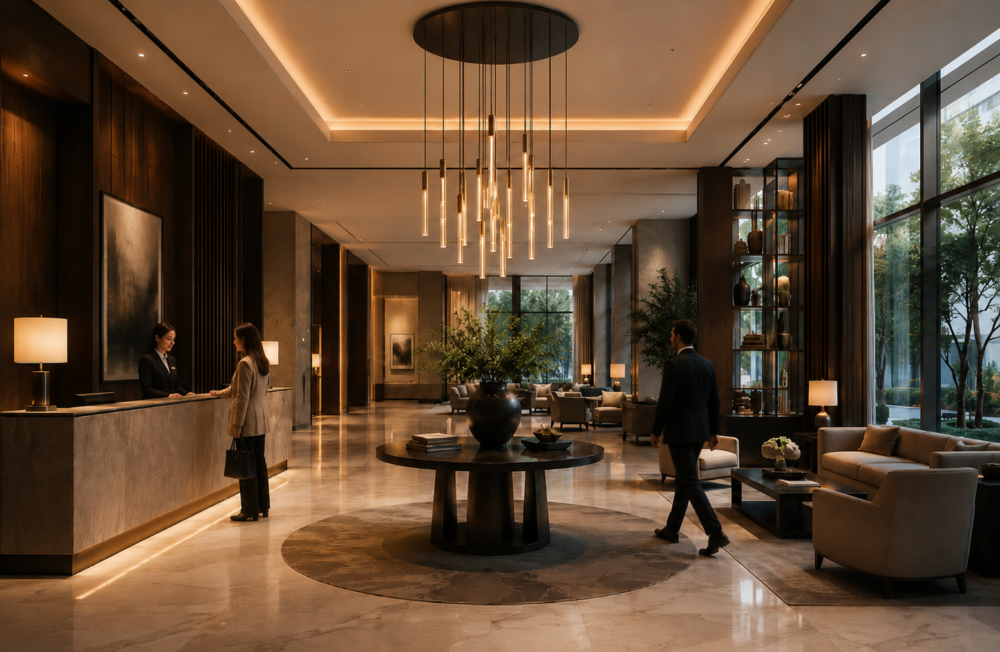
Hotel Scenting: The Invisible Layer of Guest Experience
Most hospitality leaders obsess over what guests can see. The lobby design. The lighting. The furniture. The uniforms. The amenities. All important.
Yet, some of the most powerful drivers of guest perception are completely invisible. Temperature. Acoustics. Air quality. Scent.
That is why hotel scenting has become an increasingly important part of the guest experience. Guests notice these environmental cues immediately. They just don’t talk about them.
After all, nobody has ever left a five-star review saying, “The HVAC system was excellent.” What guests do notice is when something feels wrong.
Why Guests Notice the Absence of a Commercial Odor Eliminator
One of our larger casino customers learned an unexpected lesson about scenting when a power surge silently shut down its system.
The management didn’t notice — Guests did.
Within days, complaints about cigarette smoke began appearing across the property. Yet nothing had changed. The smoking policy was the same. The ventilation system was operating normally. Occupancy levels hadn’t increased.
The only difference was that the property’s hotel scenting and odor neutralization system was no longer running.
As complaints continued to rise, the team investigated the issue and discovered that the HVAC scent system had been offline.
Once the system was restored, the complaints disappeared almost immediately.
As the casino’s director later recalled:
“Once the system was back online, the complaints stopped. That’s when I realized how much work it had been doing behind the scenes.”
It’s a revealing story because it challenges one of the biggest misconceptions about ambient scenting.
The purpose of scent marketing is not to make guests notice a fragrance but to shape their experience.
When it works well, guests rarely think about the scent itself. They simply perceive the space as cleaner, fresher, more comfortable, or more welcoming.
And often, the easiest way to understand the value of a scent diffuser is when it’s suddenly gone.
Scent Marketing Is About Perception, Not Fragrance
The objective of scent marketing is not to draw attention to the scent itself, but to reinforce how people perceive the space and the brand behind it.
Guests rarely walk into a hotel lobby and think, “What a wonderful scent.” Instead, they think, “This feels clean,” “This feels welcoming,” or “This feels premium.”
The scent becomes part of the story the space tells.
Fragrance Branding and the Psychology Behind Guest Impressions
Of course, scenting alone doesn’t create a great experience—just as lighting, architecture, or service cannot do it alone.
The strongest hospitality brands understand that experience is cumulative.
A smooth arrival. Balanced lighting. A door that closes quietly. Comfortable acoustics. A subtle signature scent.
Individually, these details seem insignificant. Together, they create something powerful: a feeling that everything is being taken care of.
This is why fragrance branding has become a strategic tool for many hospitality operators. Rather than simply adding fragrance to a space, brands use scent to reinforce recognition, emotion, and consistency across guest touchpoints.
This growing focus on sensory branding is attracting attention across the hospitality sector. Hospitality publication Hotelier & Hospitality Design recently explored how ambient scent technology is being used across the global hospitality industry to support brand differentiation and guest satisfaction.
From Hotel Lobby Scent to a Consistent Hotel Scent Experience
Many operators use a carefully curated hotel lobby scent as the foundation of a broader hotel scent strategy.
The objective is not simply to fragrance a single area. It’s to create a consistent sensory experience across the entire property.
Guests may first encounter the scent in the lobby, but the experience doesn’t have to stop there. The same olfactory signature can extend to corridors, meeting spaces, spas, retail areas, and other guest touchpoints.
When deployed consistently, scent becomes part of the property’s identity, helping reinforce familiarity and recognition throughout the guest journey.
The best hotel scents are not chosen for being the strongest or most noticeable. They are chosen because they align with the brand, complement the environment, and support the customer experience.
Guests may not consciously remember the scent itself.
But they often remember how the hotel made them feel.
And those impressions influence satisfaction, loyalty, and the likelihood of returning.
Modern HVAC Scent Systems Make Large-Scale Scenting Easier Than Ever
Modern scenting programs are also easier to deploy than many hospitality leaders assume.
Today’s HVAC fragrance system technologies integrate directly into existing ventilation infrastructure. This approach allows brands to deliver a consistent fragrance experience throughout large properties.
Why Scent Marketing Solutions Deliver Long-Term Value
As hospitality designer Raymond Matts explains:
“Walking into a space that’s scented should be subliminal, and actually work in accordance with the architecture, the color, the space itself.”
That’s why scent marketing should not be treated as decoration. It should be treated as an operational and brand tool.
The business impact can be significant. Research suggests that scent drives brand recognition for up to 60% of consumers, making it one of the most powerful sensory tools available to hospitality brands.
The most effective marketing scents become an invisible layer of the environment, shaping how guests perceive, remember, and engage with a brand over time.
In other words, a successful scent strategy is not about making a scent noticeable. It is about making an experience truly memorable.
Lucie Goutagny, Prolitec Content and Community Coordinator